biography
Henry Whysall (b. 1977, Antwerp) discovered his love of art at a very early age, sparked by a childhood trip to Florence when he was 6. Michelangelo was one of his first artistic heroes.
He studied architecture at Heriot Watt University in Scotland before committing fully to painting at Saint Martins College of Art in London. Over three years, his practice shifted from figurative work to experimental process painting, blending wax, plaster, and pigment to subtly evoke the human form.
Rooted for years in East London, Henry drew on science and experimentation, tracing visual echoes between the microscopic and the cosmic, and delving into the murky histories of alchemy with its laboratories of the impossible. At the heart of his practice lies a deep sensitivity to the sensuality and poetry of materials.
A move to Venice in 2015 brought new influences: Byzantine mosaics, sacred iconography, and the luminous tones of Murano glass were mirrored in his jewel-like, small-scale works.
Returning to Antwerp in 2019, he turned to monochrome with expressive grisaille paintings, before reintroducing bold colour in 2022.
His recent abstractions unfold as textured, intricate landscapes that draw the eye both towards then deep into the layers of the surface.
In 2024, Henry established a new studio in the historic centre of Antwerp, where his work underwent a further refinement. He is now working towards uniform surfaces that coagulate from an exuberance of materials. If the continuous surface at first, has a kind of simplicity, the work never quite hides its complex construction. If Henry is searching for a kind of beauty, it is the kind that is unashamedly smeary, wrought, pulled, pushed and exposed.
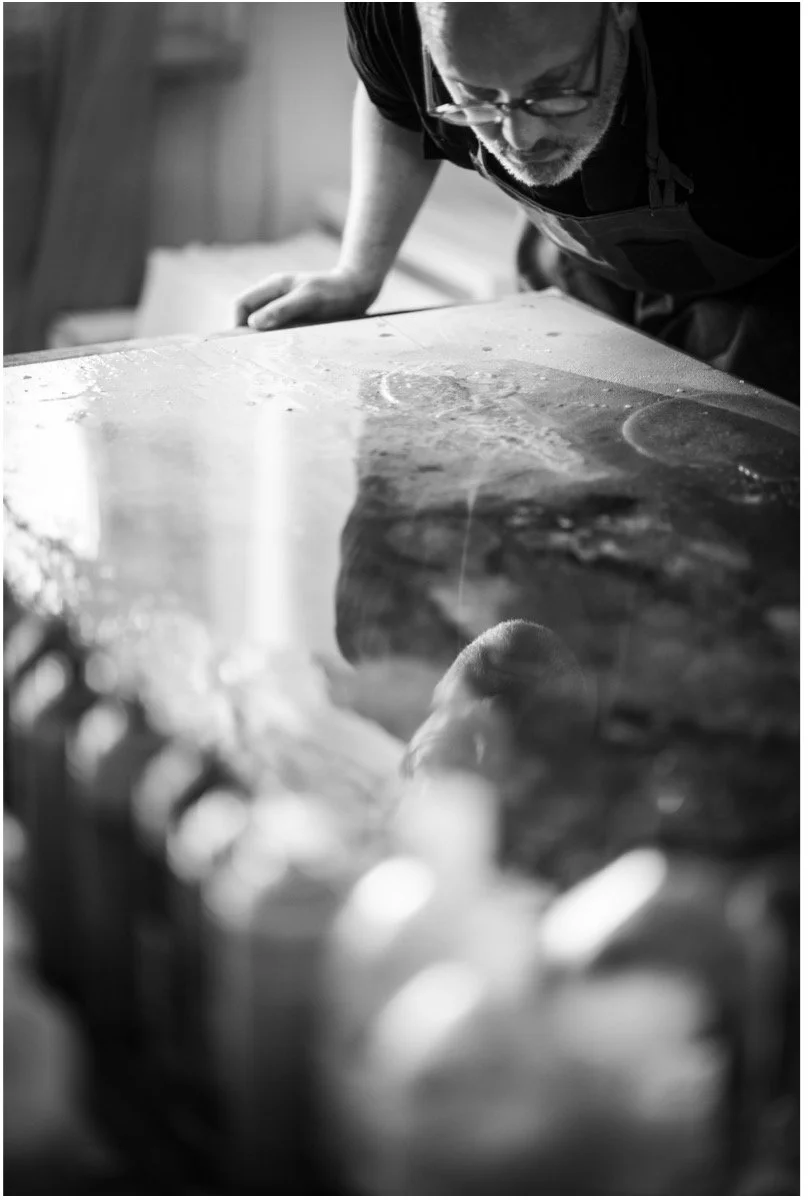
“Painting finds its vitality in matter itself.
It becomes a pursuit of a beauty that is always shifting—never fixed.
Between the microscopic and the monumental, surfaces emerge layered like living topographies. While traditional symbols may appear, they often lose their sacred weight, becoming instead evocative forms—glimmering, melancholic, and sensual.
Ultimately, painting is a space where abstraction allows the raw poetry of materials to speak, to vibrate, to resonate beyond language.”